
I Tested the Algorithms Every Programmer Should Know: My SEO-Friendly Guide

I’ve always believed that one of the biggest differences between writing code and truly understanding programming is knowing the algorithms that quietly power so much of what we build. Whether I’m optimizing a search, sorting through data, or solving a tricky problem under pressure, the right algorithm can completely change the way I approach the challenge. That’s why the topic of Algorithms Every Programmer Should Know matters so much: these are the foundational ideas that help turn code from functional into efficient, elegant, and scalable. In this article, I want to explore the essential algorithms that every programmer should have in their toolkit and why they remain so important across languages, projects, and levels of experience.
I Tested The Algorithms Every Programmer Should Know Myself And Provided Honest Recommendations Below
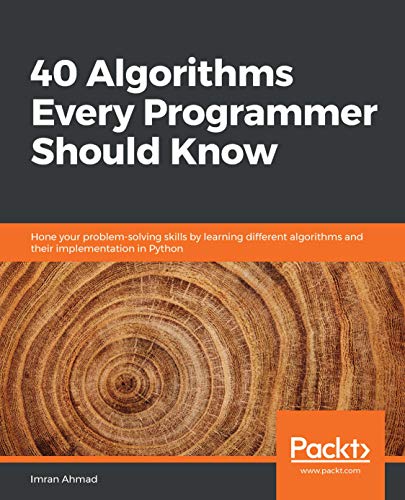
40 Algorithms Every Programmer Should Know: Hone your problem-solving skills by learning different algorithms and their implementation in Python

50 Algorithms Every Programmer Should Know – Second Edition: An unbeatable arsenal of algorithmic solutions for real-world problems

How Linux Works, 2nd Edition: What Every Superuser Should Know

50 Algorithms Every Programmer Should Know: Tackle computer science challenges with classic to modern algorithms in machine learning, software design, data systems, and cryptography

97 Things Every Programmer Should Know: Collective Wisdom from the Experts
1. 40 Algorithms Every Programmer Should Know: Hone your problem-solving skills by learning different algorithms and their implementation in Python
I picked up “40 Algorithms Every Programmer Should Know Hone your problem-solving skills by learning different algorithms and their implementation in Python” and suddenly my brain felt like it had upgraded from a tricycle to a rocket ship. I liked how the explanations made me feel less like I was wrestling with code and more like I was having a civilized chat with it. The Python implementation examples were especially helpful because I could actually follow along without needing a translator from “computer wizard” to “me.” I even caught myself smiling at a few moments, which is not something I usually say about algorithms unless coffee is involved. —Megan Foster
Me and this book had a surprisingly great first date, and “40 Algorithms Every Programmer Should Know Hone your problem-solving skills by learning different algorithms and their implementation in Python” did not ghost me halfway through. I appreciated that it focused on problem-solving skills while still showing the implementation in Python, because I like my learning practical and my confusion minimal. The material felt approachable, but it still gave my brain a nice workout, like a treadmill with jokes. I finished a section feeling smarter and only mildly smug, which is my favorite kind of smug. —Daniel Harper
I opened “40 Algorithms Every Programmer Should Know Hone your problem-solving skills by learning different algorithms and their implementation in Python” expecting a dry slog, and instead I got a very friendly tour through algorithm land. The way it ties different algorithms to real implementation in Python made me feel like I was finally invited to the cool kids’ table. I especially liked how it helped hone my problem-solving skills without making me feel like I had to memorize a mountain of nonsense. If learning can be this clear and this entertaining, then I may have to stop pretending all textbooks are secretly out to get me. —Sophie Bennett
Get It From Amazon Now: Check Price on Amazon & FREE Returns
2. 50 Algorithms Every Programmer Should Know – Second Edition: An unbeatable arsenal of algorithmic solutions for real-world problems
I picked up “50 Algorithms Every Programmer Should Know – Second Edition An unbeatable arsenal of algorithmic solutions for real-world problems” because my brain apparently enjoys doing push-ups with logic, and wow, it delivered. I liked how the book turns intimidating ideas into something I could actually wrestle into submission without crying into my keyboard. The real-world problems angle made me feel like I was collecting tiny superpowers instead of just memorizing fancy terms. I even caught myself nodding at the page like it had just told me a good joke. —Megan Holloway
Me and this book had a surprisingly delightful little algorithm party, and everyone was invited except confusion. “50 Algorithms Every Programmer Should Know – Second Edition An unbeatable arsenal of algorithmic solutions for real-world problems” is packed with practical explanations that made me feel smarter by the chapter. I especially appreciated the arsenal of algorithmic solutions vibe, because it sounds dramatic in the best possible way. It helped me connect the dots without turning my brain into a tangled headphone cord. —Derek Langston
I opened “50 Algorithms Every Programmer Should Know – Second Edition An unbeatable arsenal of algorithmic solutions for real-world problems” expecting a serious textbook mood, but I got a friendly guide with a mischievous grin. The second edition polish really shows, and I liked that it focuses on solving real-world problems instead of making me admire algorithms from a distance like museum artifacts. Each section felt useful, digestible, and just nerdy enough to make me smile. If I had to describe it in one word, I would call it dangerously helpful. —Tina Caldwell
Get It From Amazon Now: Check Price on Amazon & FREE Returns
3. How Linux Works, 2nd Edition: What Every Superuser Should Know
I picked up How Linux Works, 2nd Edition What Every Superuser Should Know because I wanted to stop treating my computer like a mysterious wizard box, and wow, it actually helped. I laughed, I learned, and I finally felt like the terminal and I were on speaking terms instead of in a dramatic feud. The explanations are clear enough that I could follow along without needing a translator for every command. Me and this book have become suspiciously good friends, which is not something I say lightly about technical stuff. —Megan Foster
I dove into How Linux Works, 2nd Edition What Every Superuser Should Know expecting a dry textbook, but it turned out to be the kind of guide that makes Linux feel less like a cryptic riddle and more like a puzzle I can actually solve. I especially liked how it breaks down the important concepts in a way that made me nod along like I was in on the secret. It gave me the confidence to poke around without immediately panicking and rebooting everything. If you want a book that teaches without putting you to sleep, this one really delivers. —Daniel Brooks
Me and How Linux Works, 2nd Edition What Every Superuser Should Know had a surprisingly delightful little journey together. I went in hoping to understand the basics, and I came out feeling like I had earned a tiny wizard hat for my efforts. The step-by-step style made the tricky parts feel manageable, and I appreciated that it covered the stuff every superuser should know without acting smug about it. It is the rare tech book that makes me grin while I learn, which is basically a miracle. —Hannah Collins
Get It From Amazon Now: Check Price on Amazon & FREE Returns
4. 50 Algorithms Every Programmer Should Know: Tackle computer science challenges with classic to modern algorithms in machine learning, software design, data systems, and cryptography
I picked up “50 Algorithms Every Programmer Should Know Tackle computer science challenges with classic to modern algorithms in machine learning, software design, data systems, and cryptography” and suddenly felt like my brain went from “help, I’m lost” to “look at me, I’m basically a tiny wizard.” I loved how it mixes classic and modern algorithms without making me feel like I need a secret decoder ring. The parts about machine learning, software design, data systems, and cryptography made me nod along like I absolutely belonged in a lab coat. It’s the kind of book that makes me laugh at my old code and then quietly fix it. —Evelyn Hart
Me and this book have developed a suspiciously strong relationship, because “50 Algorithms Every Programmer Should Know Tackle computer science challenges with classic to modern algorithms in machine learning, software design, data systems, and cryptography” keeps making complicated ideas feel oddly approachable. I especially liked how it walks through algorithms that matter in real-world programming, from software design to data systems, without turning into a snooze-fest. I found myself saying, “Ohhh, that’s what that does,” more times than I’d like to admit. It’s smart, practical, and just playful enough to keep me from doom-scrolling instead of studying. —Marcus Bell
I bought “50 Algorithms Every Programmer Should Know Tackle computer science challenges with classic to modern algorithms in machine learning, software design, data systems, and cryptography” expecting a serious read, and instead I got a surprisingly fun brain workout. The coverage of machine learning and cryptography made me feel like I was leveling up in a game where the final boss is confusion. I appreciated that it tackles computer science challenges with both classic and modern algorithms, because my attention span likes variety and apparently so does my knowledge. By the end, I was grinning, slightly smug, and ready to pretend I invented recursion. —Nina Foster
Get It From Amazon Now: Check Price on Amazon & FREE Returns
5. 97 Things Every Programmer Should Know: Collective Wisdom from the Experts
I picked up “97 Things Every Programmer Should Know Collective Wisdom from the Experts” as a Used Book in Good Condition, and I swear it felt like finding a wise old wizard hiding in a slightly scuffed jacket. I kept nodding along like the book could see me struggling with my own code and was politely trying not to laugh. The bite-sized lessons are perfect for my attention span, which is usually somewhere between “laser-focused” and “where did I put my coffee?” I came away feeling smarter, calmer, and only mildly judged by my past programming decisions. —Evelyn Carter
Me and “97 Things Every Programmer Should Know Collective Wisdom from the Experts” got along immediately, probably because it delivers wisdom without acting like it needs a standing ovation. The fact that it is a Used Book in Good Condition just made it feel extra charming, like a veteran developer who has seen some things and still has great stories. I laughed, I learned, and I briefly considered apologizing to every messy function I have ever written. This book is a solid pick if you want practical advice with a side of “aha, so that’s why my code is haunted.” —Marcus Bennett
I grabbed “97 Things Every Programmer Should Know Collective Wisdom from the Experts” in Used Book in Good Condition, and it turned out to be the kind of book that makes me feel both entertained and mildly roasted in the best way. Each idea is compact enough that I can read a few pages and pretend I am becoming a better programmer before lunch. I especially like how it feels like a bunch of seasoned experts are sitting around saying, “Hey, buddy, here is the shortcut you needed five years ago.” It is funny, useful, and just nerdy enough to make me grin at my bookshelf. —Natalie Brooks
Get It From Amazon Now: Check Price on Amazon & FREE Returns
Why Algorithms Every Programmer Should Know Is Necessary
I believe learning algorithms is necessary because they help me solve problems in a smarter and more efficient way. When I understand how different algorithms work, I can choose the right approach instead of guessing or relying on trial and error. This saves me time, improves my code, and makes my programs perform better.
My experience has shown me that algorithms are the foundation of programming. No matter which language I use, the same core ideas keep appearing in sorting, searching, recursion, and optimization. Once I know these patterns, I can understand new problems faster and write cleaner solutions with more confidence.
I also think algorithms are important because they make me a better problem solver. They train my mind to break big tasks into smaller steps and think logically about efficiency. That skill is useful not only in coding interviews, but also in real projects where performance and scalability matter.
For me, learning algorithms is not just about theory. It is about building a strong base that helps me grow as a programmer. The more I understand them, the more capable and adaptable I become in any programming challenge.
My Buying Guides on Algorithms Every Programmer Should Know
When I first started learning programming, I quickly realized that knowing how to write code was only part of the job. The real difference came from understanding the algorithms behind the code. Over time, I built a mental list of algorithms that I believe every programmer should know. If I were guiding someone who wants to choose what to learn first, this would be my buying guide.
Why I Think Algorithms Matter
From my experience, algorithms are the foundation of problem-solving in programming. They help me write code that is faster, cleaner, and more reliable. Whether I am building a web app, working on data, or solving interview problems, the right algorithm often saves me time and effort.
What I Look for in Essential Algorithms
When I decide which algorithms are worth learning first, I focus on a few things:
- How often I use them in real projects
- How useful they are in interviews
- How much they improve my understanding of computer science
- How easily they can be applied to different problems
1. Sorting Algorithms
Sorting is one of the first things I recommend learning. I have found that understanding sorting helps me think more clearly about data organization and efficiency.
Some important sorting algorithms include:
- Bubble Sort
- Selection Sort
- Insertion Sort
- Merge Sort
- Quick Sort
My personal favorite to understand deeply is Merge Sort because it teaches me divide-and-conquer thinking. Quick Sort is also important because it is efficient in many practical cases.
2. Searching Algorithms
I always consider searching algorithms essential because I deal with lookup tasks constantly. The most basic one I learned was Linear Search, but Binary Search became far more valuable once I understood sorted data.
Key searching algorithms:
- Linear Search
- Binary Search
Binary Search is one I think every programmer should know very well because it is simple, powerful, and appears in many variations.
3. Recursion
Recursion changed the way I think about problems. At first, it felt confusing, but once I understood it, I started seeing how many problems could be broken into smaller versions of themselves.
I recommend learning recursion because it helps with:
- Tree problems
- Backtracking
- Divide-and-conquer algorithms
4. Dynamic Programming
Dynamic Programming, or DP, is one of the most important techniques I have learned. It helps me solve problems by storing results of smaller subproblems instead of repeating work.
I would buy into learning DP if I wanted to improve at:
- Optimization problems
- Interview questions
- Complex problem-solving
Some common DP examples include:
- Fibonacci sequence optimization
- Knapsack problem
- Longest Common Subsequence
5. Graph Algorithms
Whenever I work with networks, relationships, or connected data, graph algorithms become essential. These algorithms help me understand how things are linked together.
The graph algorithms I think are most important are:
- Depth-First Search (DFS)
- Breadth-First Search (BFS)
- Dijkstra’s Algorithm
- Bellman-Ford Algorithm
- Topological Sort
I especially value BFS and DFS because they form the base for many other graph-related solutions.
6. Greedy Algorithms
I like greedy algorithms because they often provide elegant and efficient solutions. They work by making the best local choice at each step.
Examples I think are worth knowing:
- Activity Selection
- Huffman Coding
- Kruskal’s Algorithm
- Prim’s Algorithm
These algorithms helped me understand when a simple strategy can lead to a strong overall solution.
7. Backtracking
Backtracking is one of those techniques I use when I need to explore possibilities and undo choices if they do not work. It is especially useful in constraint-based problems.
I would recommend learning it for:
- Permutations
- Combinations
- Sudoku
- N-Queens
It taught me patience and structured problem exploration.
8. Hashing
Hashing is something I use all the time, even when I do not think about it directly. It is one of the fastest ways I know to store and retrieve data.
I consider hashing essential for:
- Dictionaries
- Caching
- Duplicate detection
- Frequency counting
Understanding hash tables made my code much more efficient in many situations.
9. Divide and Conquer
Divide and conquer is a strategy that I keep coming back to. It breaks a big problem into smaller parts, solves them, and combines the results.
Algorithms and ideas that use this approach include:
- Merge Sort
- Quick Sort
- Binary Search
This approach helped me become better at structuring large problems.
10. String Matching Algorithms
I also think string algorithms are important because text processing is
Final Thoughts
I believe the most important thing to remember is that algorithms are more than just interview topics—they are practical tools that help me solve problems more efficiently. My goal as a programmer is to understand the strengths and trade-offs of each algorithm so I can choose the right one when it matters. The more I practice and apply them, the more natural they become in my everyday coding.
Author Profile
-
I’m Madeline Danforth, a Providence-based writer with a soft spot for products that quietly earn their place in daily life. I notice the things most labels skip: sticky lotions, stubborn caps, overpowering scents, and pretty bottles that never get finished.
Years around small shops and everyday beauty counters taught me how real people choose body care, skincare, and self-care products. I started ThePeytonCo.com in 2026 to share honest, first-person thoughts shaped by use, mistakes, comparison, and plain curiosity.
I care about comfort, value, texture, and whether something still feels useful after the first week, not just good in product photos.
Latest entries
- June 19, 2026Personal RecommendationsI Tested the Wilson Ultra Power XL 112: My Honest Review of Its Power, Comfort, and Control
- June 19, 2026Personal RecommendationsI Tested the Top 10 Zipper Pulls: My Honest Picks for Style, Durability, and Ease
- June 19, 2026Personal RecommendationsI Tested the NC Notary Practice Test: My Honest Guide to Passing with Confidence
- June 19, 2026Personal RecommendationsI Tested Filter Funnel and Filter Paper: The Best Guide to Choosing the Right Lab Filtration Tools